
Running a Sex Offender Check in Loving County
The Texas Public Sex Offender Registry is the first official channel for a Loving County search. Texas DPS manages the database, while the Loving County Sheriff's Office performs local registration and verification work for people who reside in the county. Search by a person's name when identity is the main question. Use an address, ZIP code, county filter, or map when the concern is a place. Name spelling, aliases, and a prior address may help when an expected match does not appear.
A result is only a public snapshot. It may show a mapped residence, physical descriptors, a reportable offense, dates, and registration status, but protected identifiers and victim information are withheld. For a person who may have crossed a state line, add the national search rather than treating the Texas result as complete. Questions about a Loving County registrant's local reporting status belong with the sheriff, not the combined county and district clerk. The clerk keeps criminal case files, which answer a different question about charges and outcomes.
Loving County Registry Registration
Loving County has no incorporated municipality, city police department, or city registrar. A person who resides in unincorporated Loving County reports to the sheriff as the local law-enforcement authority. The sheriff's official office page lists 114 West Collins Street in Mentone and weekday office hours. Call (432) 377-2411 and ask for the registration officer before traveling. The site does not publish a separate registry desk, appointment calendar, or local fee.
This local route matters because a courthouse visit will not replace the report to law enforcement. The county sheriff page supplies the same non-emergency number, while the Texas registry supplies the public search. The sheriff handles local compliance questions; DPS manages the statewide public record. Someone reviewing an old criminal case can contact the combined clerk, but a docket does not confirm whether today's registration duty was met.
Note: Confirm the registration officer and appointment details by phone because Loving County publishes no separate registry-counter schedule.
Searching the Texas Public Sex Offender Registry
DPS offers name and location paths through its official registry. Begin with the broadest reliable details, then narrow the result. The portal's live controls can change, so use the labels shown at search time and do not guess at a radius value. A county filter is useful for Loving County, yet an address search may be better near a county line. Read the conditions of use before submitting a search.
- Open the official DPS registry and accept its use terms.
- Enter a name or choose a location search with address, ZIP, or Loving County.
- Compare aliases, physical details, and mapped location before selecting a match.
- Open the full public profile and review offenses, dates, risk information, and registration status.
| Field Label | Type | Required | Notes |
|---|---|---|---|
| Name | Text | Search-dependent | Use the known spelling and check aliases on a profile. |
| Address or location | Address | Search-dependent | Search around a Texas location. |
| ZIP | Text/filter | No | Narrows a geographic search. |
| County | Dropdown/filter | No | Select Loving County for county results. |
| Map or list | View control | No | Switches between spatial and list views. |
The official registry search interface shows how DPS separates name, place, and map searches.
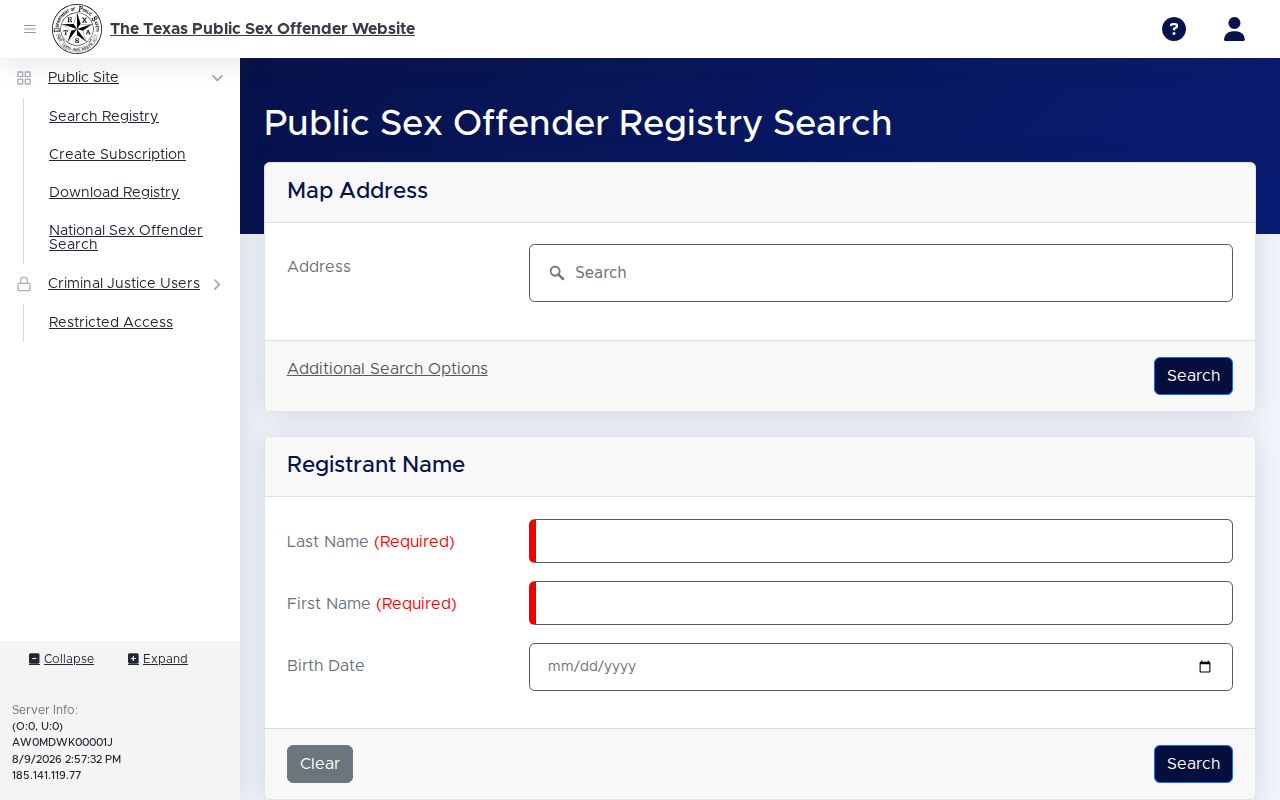
The search screen is the correct starting point for current public data, but the full profile provides the context needed to interpret a match.
Loving County and NSOPW
The National Sex Offender Public Website adds an official cross-state layer. Its name, ZIP, and address-radius tools search participating public registries through one federal interface. That helps when a person recently moved, uses an alias, or may be registered outside Texas. It also helps residents near state and county boundaries avoid a search confined to one jurisdiction.
NSOPW does not replace the Texas profile. Each state supplies its own data and applies its own public-display rules. Use the national result to identify the contributing jurisdiction, then open that jurisdiction's official profile and read its labels. A blank Loving County result is not a promise that no relevant record exists nearby. Address changes, reporting delays, spelling differences, and moves across state lines can affect what one query returns.
The official NSOPW search presents this national layer without relying on a private people-search database.
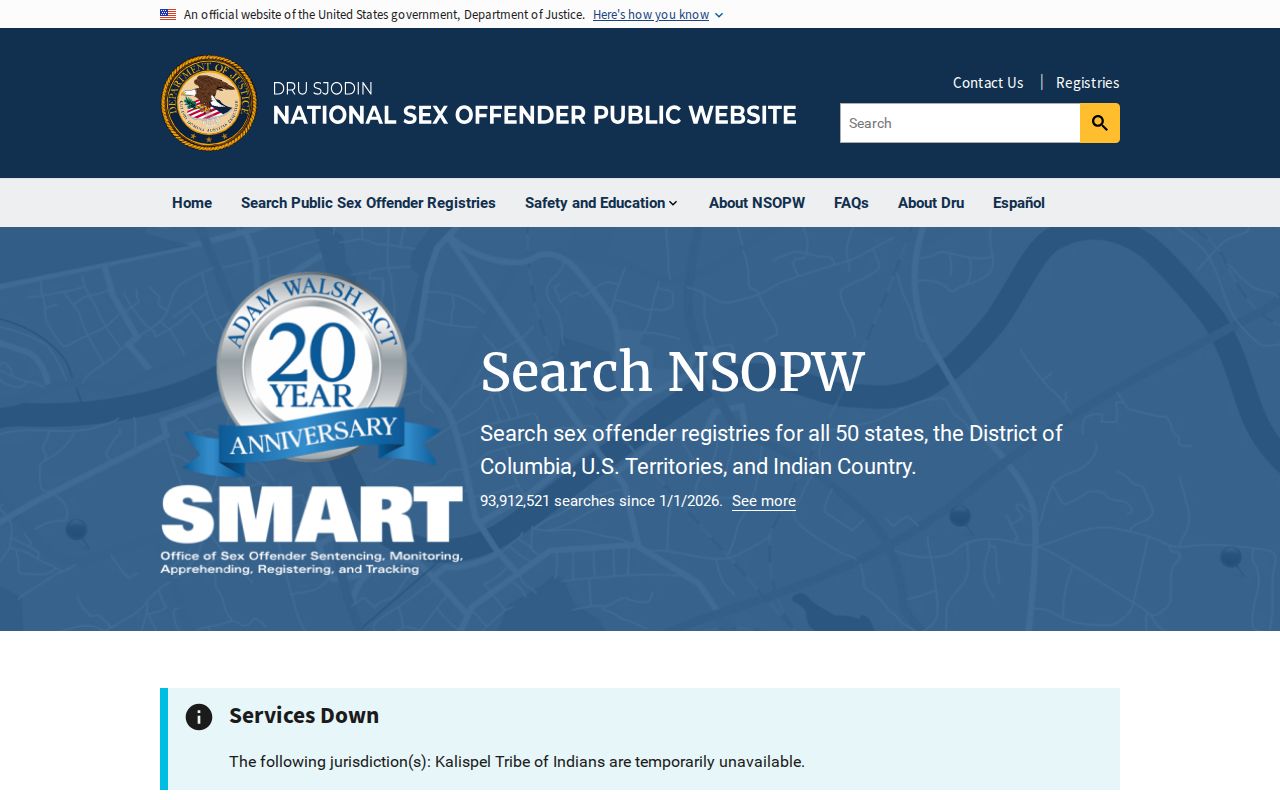
Use that wider search as a supplement, then verify the details with DPS or the state that maintains the source profile.
What a Registry Profile Shows
A public Texas profile combines identity, location, offense, and status fields that Chapter 62 allows DPS to publish. Read the fields together. A similar name is not enough for a sound match, and a map point alone says little about the underlying record. Photos and physical descriptions can help distinguish people, while aliases and conviction dates provide more context. Registration status concerns the duty to report; it is not a claim of a new offense.
| Name & Aliases | Published identity names used to distinguish a record. |
|---|---|
| Photo & Physical Description | Public image and descriptors such as sex, race, height, weight, eyes, and hair. |
| Registered Address | The public residence address or detailed location allowed by law. |
| Offense & Dates | Reportable offense, conviction date, and punishment details in the public subset. |
| Risk Designation | Texas low, moderate, or high public-safety assessment when shown. |
| Registration Status | Current public status and other compliance information DPS makes available. |
Some registration data is collected but not released to the public. That boundary protects identifiers and victims while still supporting community awareness. If a field is unclear, use the registry's definitions or ask DPS. Do not fill gaps with information from an unofficial profile.
Loving County Registry Privacy Limits
Texas collects more registration information than the public profile reveals. Social Security numbers, driver's-license numbers, telephone numbers, online identifiers, employer contact information, victim-identifying facts, and confidential DPS material are not public registry fields. Juvenile registration can also remain nonpublic when a court order requires it. A missing field is often a legal privacy boundary, not a portal failure.
The distinction helps explain why the sheriff, DPS, and the public see different versions of the same registration record. The sheriff needs details to carry out verification. DPS uses the full submission to manage the system. The public receives the statutory subset. Someone seeking the underlying Loving County criminal judgment should contact the combined county and district clerk, but sealed or otherwise restricted court material will not be released through a registry request.
Registration Requirements and Levels in Texas
Texas risk level and registration duration are separate rules. Level 1 means the assessment found low danger; Level 2 means moderate danger; Level 3 means serious danger with an expectation of continued criminal sexual conduct. Those labels are not federal SORNA tiers. More importantly, a risk number does not set the end date. The reportable offense controls whether an adult duty is generally for life or for ten years after the applicable release, discharge, or supervision milestone.
| Level / Tier | Duration | Verification Frequency |
|---|---|---|
| Level 1 / low | Offense controls, often ten years or life | Usually annual unless another rule applies |
| Level 2 / moderate | Offense controls, not the risk level | Usually annual unless another rule applies |
| Level 3 / high | Offense controls, not the risk level | Usually annual unless another rule applies |
| Two or more sexually violent offenses | Underlying offense rule controls | Every 90 days |
| Civil commitment | Underlying lifetime duty generally controls | Every 30 days |
Juvenile adjudication generally carries a different ten-year measure tied to disposition or its completion, subject to court orders. Always consult the DPS registration requirements and the actual judgment rather than inferring an end date from a color or risk label.
Loving County Registry Zone Rules
Texas Chapter 62 does not create one statewide school or park distance that applies to every registrant. Conditions of parole or community supervision can create child-safety zones for a particular person. A city ordinance may add a local rule in some places, but Loving County has no incorporated municipality. It is therefore wrong to copy a distance from another Texas city and present it as a Loving County rule.
Read the person's controlling court order and supervision terms when a location restriction matters. The public registry map identifies reported locations; it does not display every condition from a supervision file. The sheriff can explain local registration procedure, while the sentencing court or assigned supervision office is the source for an individual condition. This separation prevents a public map from being treated as a complete legal file.
Texas Code of Criminal Procedure Chapter 62 governs registration and public registry information; it does not impose one universal statewide distance.
Loving County Registry Verification
Most registrants verify annually, while a person with two or more sexually violent offenses verifies every 90 days and a civilly committed sexually violent predator verifies every 30 days. A person moving to Loving County generally must report by the later of seven days after arrival or the first date local policy permits. An intended Texas address change also requires advance in-person notice, followed by reporting to the new authority within seven days after arrival.
DPS sends English and Spanish postcard notices for high-risk or civilly committed arrivals. The stated area is one mile in an unsubdivided place or three blocks in a subdivided area. A CRD public account can also support Public Sex Offender Subscriptions. Report suspected noncompliance to the Loving County sheriff. Give the observation and location without confronting the listed person, and let law enforcement determine whether a duty was breached.
Note: Registry subscriptions can aid awareness, but direct sheriff and DPS confirmation remains best when a status appears stale or unclear.
Lawful Use and Community Notification
Registry information supports awareness and practical safety planning. Compare the correct person's identifiers, read the offense and date, and note whether the address is exact or described as a location. A historical conviction does not prove new conduct, and a risk designation is not a prediction about a specific day. If a profile appears wrong, preserve the public record details and refer the issue to DPS or the Loving County sheriff rather than changing or circulating the data.
Community notification and public subscriptions add timely signals, but they do not replace ordinary precautions. Families can use the official map to understand nearby reported locations and use NSOPW when travel or a move crosses state lines. Avoid reposting protected details or turning registry data into a public accusation. The Texas program is an official information channel with strict limits.
Do not misuse registry data: Harassing, threatening, intimidating, or confronting a registrant or household is unlawful, and misuse of information governed by Texas Chapter 62 can carry legal penalties.